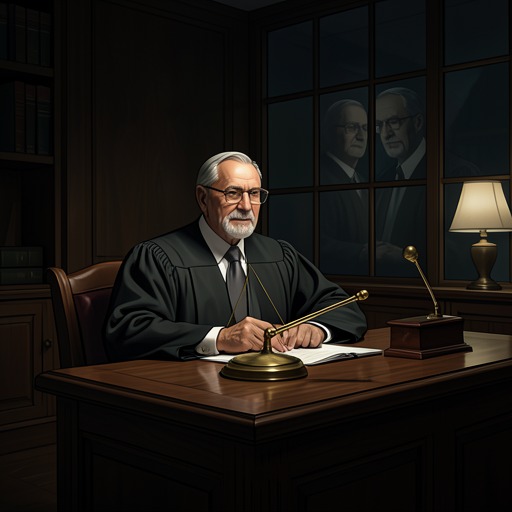
French Supreme Court of Appeal
An Officer and a SpyThe French Supreme Court of Appeal became the decisive judicial forum for overturning Alfred Dreyfus’s Rennes conviction and establishing his complete exoneration. The account presents its intervention not as a sudden reversal, but as the end of a slow transfer of the case from military control into renewed legal scrutiny, after years of concealed evidence, restricted inquiry, and political delay.
Position in the Affair
The court’s role emerged against the limits of the earlier military proceedings. At Dreyfus’s original hearing, the prosecution sought a private session on the ground that the evidence concerned national defence; the defense objected that this would deny Dreyfus the equal treatment due to any accused person. The claim of military sensitivity thus helped define the conditions under which the original case was judged, while also making scrutiny of its evidence more difficult.
Later, when Georges Picquart presented his investigation to Charles-Arthur Gonse, he explained that the case file did not establish Dreyfus’s guilt and would not withstand competent cross-examination. Gonse urged him to investigate Ferdinand Walsin Esterhazy if he wished, but to leave the bordereau out of that inquiry. This distinction kept the new evidence about Esterhazy from reopening the question at the heart of Dreyfus’s conviction.
Limits on Re-examination
The account shows military officials trying to contain the case through both argument and command. Gonse acknowledged that the original investigation had not been handled professionally, citing Jean Sandherr’s illness and Armand du Paty de Clam’s involvement, but argued that reopening the matter would revive wounds and risk tearing the country apart. He then formally ordered Picquart to stop investigating anything connected with Dreyfus and to disclose nothing to unauthorized people.
That institutional resistance also shaped the later inquiry into Picquart. When he challenged its scope, he pointed to the evidence that Ferdinand Walsin Esterhazy had plainly written the bordereau, a conclusion supported even by the government’s principal handwriting expert, and raised the use of falsified material in the dossier that had convicted Dreyfus. He was told that these questions fell outside the inquiry’s remit. These exchanges were not actions of the Supreme Court itself; they show the military restrictions and unresolved claims that a later judicial review had to confront.
Route to Review
The route toward reconsideration began to open through political and legal pressure. After Georges Clemenceau helped Picquart draft an open letter to Prime Minister Henri Brisson, Picquart stated that the two secret documents dated 1894 could not be applied to Dreyfus and that the document dated 1896 showed signs of forgery. The letter challenged the evidentiary basis publicly invoked by the Minister of War and helped make the concealed dossier a matter for renewed scrutiny.
In 1903, Jean Jaurès delivered a day-and-a-half speech in the French Chamber of Deputies laying out the affair. The account identifies this intervention as the prompt for the new Minister of War, General André, to examine the evidence again. The result of André’s inquiry led the Criminal Chamber to take up the case and conclude, in 1904, that it should be reviewed by the Supreme Court of Appeal. This sequence distinguished the new judicial route from the military proceedings that had first convicted Dreyfus: the review depended on reopening the record rather than accepting the earlier judgment as conclusive.
The process did not move directly to judgment. Political turmoil over the separation of Church and State consumed 1905, delaying the final resolution. The account emphasizes the painstaking character of the eventual outcome: the facts were sifted repeatedly by jurists in committees and archives, rather than settled in a dramatic courtroom climax.
Judgment and Consequences
On 12 July 1906, the French Supreme Court of Appeal quashed the Rennes verdict and exonerated Dreyfus entirely. The ruling resolved the legal status of a man who had accepted a pardon despite the implication of guilt: Picquart had protested that accepting it amounted to an admission, while a statement prepared for Dreyfus affirmed that freedom without restored honour meant little and that he would continue seeking reversal of the judicial error. The court’s decision supplied the formal vindication that a pardon alone could not provide.
The political consequences followed the next day, but belonged to a separate parliamentary process. The French Chamber of Deputies voted to restore Dreyfus to the army as a major and award him the cross of the Legion of Honour by 432 votes to 32. It also voted to restore Picquart, who had been dishonourably discharged in 1898, by 449 to 26. The Supreme Court’s judgment therefore did more than overturn one verdict: it made possible a public reckoning with the conviction and the losses it had caused, while the subsequent votes translated that judicial reversal into institutional restoration.